-1.png?width=902&height=215&name=image%20(56)-1.png "Diliforce Growth Governance Platform")
Your company already runs on connections. What if your governance could see them?
Every leadership decision rests on the same question: what does the whole picture look like right now? Which contracts are live, which obligations are coming due, which board decisions still bind us, and how one change ripples through the rest.
The information exists — in board minutes, contracts, entity records, and financial documents. But it sits in separate documents, and the connections between them live only in people's heads. So decisions get made on a partial picture, and someone spends days reconstructing the rest when it matters.
The Governance Graph closes that gap. It turns your governance information into a living structure that connects every entity, contract, obligation, and decision — and keeps that picture current as new governance information arrives. This post explains what that means, and why it changes the day-to-day for everyone who runs the business, not just the legal team.
What is the Governance Graph?
You've probably noticed that Diliforce is going all-in on AI. We've already brought AI agents into the day-to-day work of handling your documents.
The next step is what the whole field is moving toward: the graph.
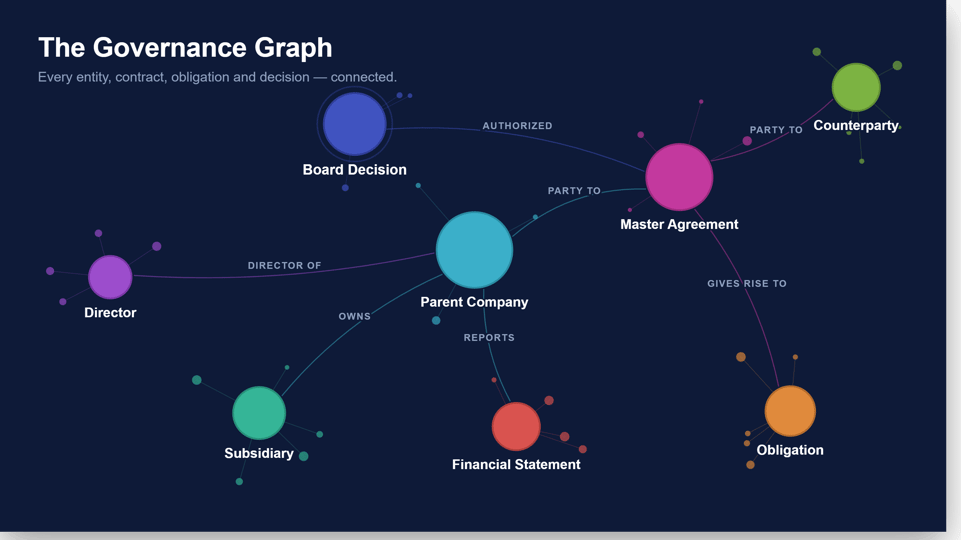
Graph-grounded AI — agents that reason over an explicit map of entities and relationships, rather than guessing from raw text — is emerging as one of the next competitive frontiers in enterprise AI.
Our advantage is that governance data already has exactly this structure — and much of the data needed to build the graph already lives in Diliforce.
The Governance Graph maps how the parts of your governance world relate to one another. Companies, board members, contracts, obligations, and counterparties become points on a shared map, connected by relationships: this company owns that subsidiary; this company is party to that contract; this obligation comes from that agreement; this board decision authorized that commitment.
The documents are still there — they're the raw material. The graph is the machine-readable structure built from them.
This fits governance especially well, because governance is already a web of relationships: who owns what, who authorized what, what binds whom, and when an obligation falls due. A graph doesn't force your data into an unnatural shape; it makes visible the structure that was always there.
And Diliforce has an unusual starting position. Board meetings, contract management, entity management and virtual data rooms already live on the same platform. That makes it possible to connect information across them, rather than treating each area in isolation.
Why "living" is the important word
The graph isn't a snapshot you build once and let go stale. It's alive — and that's the whole point.
As your company operates, it constantly produces new governance information. A board meeting doesn't just generate minutes and board packs; it generates decisions, approvals and obligations. A new contract adds parties, dates and clauses. Financial records, entity changes, signed agreements — all of it keeps arriving.
AI agents read each new document, pull out what matters, and add it to the graph as new points and relationships. The graph grows and evolves as the business moves.
The company effectively lives inside its own governance data: its governance information connects across the business, and the connections stay current because the agents maintain them.
A shared situational picture — and a basis for decisions
This is where it stops being a technical idea and starts being an everyday one.
Because the graph is current and connected, it gives every leader a live situational picture of the part of the business they're responsible for — and how it links to the rest.
-
A CEO sees the whole: what's committed, what's exposed, what a given change would touch.
-
A General Counsel can trace which board decisions authorized which commitments, and where a clause in one contract has consequences elsewhere.
-
A CFO sees the financial obligations and how they tie back to contracts and entities across the group.
-
A head of sales can see the sales contract portfolio and its terms — what customers have committed to, what conditions apply, and what's coming up for renewal.
-
Board members, compliance and finance teams all draw on the same connected picture rather than each maintaining their own partial version.
The value isn't a report you request once a quarter. It's a shared basis for decisions, available whenever a decision has to be made — grounded in explicit relationships rather than someone's best recollection.
How do the agents actually work?
Think of the AI agents as specialized digital colleagues, and the graph as their shared memory and map. They work in a simple loop:
-
Read. A document arrives. An agent identifies the parties, dates and obligations.
-
Connect. Those details are added to the graph, linked to the right entities and people.
-
Reason. Agents traverse the relationships to spot deadlines, compliance risks and anomalies, or to answer a question.
-
Act. An agent alerts someone, drafts something, or answers — and shows the exact path through your governance information that the answer is based on.
That last part matters. A language model reading through loose documents can find relevant text and infer an answer from it. A graph-grounded agent has far less room for guesswork: it reasons over explicit relationships rather than inferring from text. That reduces hallucination risk and makes every conclusion traceable — you can show how an answer was reached, not just assert it.
Take a concrete case: which board decision authorized this contract, and is it still within that mandate? An agent can follow contract → board resolution → meeting → approvers and show the full chain of authority — something a contract tool or a board portal can't do on its own.
The graph reaches outward, too
A living graph doesn't just stay in step with what happens inside your company — it can also be enriched by what happens outside it. External intelligence keeps relevant parts of the graph current: regulatory changes can be mapped to the contracts and entities they affect, entity data verified against official registers, and counterparty information monitored as it changes.
And through MCP, the emerging standard for connecting AI tools, the Governance Graph can also connect to legal AI platforms, document automation systems, and custom agents. Those tools can draw on governance context from the graph, and their output can flow back into Diliforce as governed records.
What about security?
AI processing runs on Microsoft Foundry, all documents stay inside the customer's own isolated Diliforce account in Azure, and within each user's access rights.
Customer data is never used to train AI models.
And yes — this makes due diligence easier too
When the graph is live, and everything is connected, due diligence stops being a project you brace for. A question like what happens if we sell one of our subsidiaries? runs across the subsidiary, its contracts, change-of-control clauses, counterparties and continuing obligations — and the graph already holds those links. A question that once took days of manual review becomes a path the agent can follow, with sources attached.
But that's a byproduct, not the point. Because the picture stays current and transparent, you can demonstrate the state of the business — and its value — at any moment. Due diligence readiness is simply what continuous governance looks like when someone asks to see it.
Why this compounds
Every new contract, board decision, entity record and governed document adds context and relationships to the graph. A richer graph makes every agent smarter, and new agents can plug into the same graph without a separate integration each time.
Governance stops being a pile of documents you search when something happens, and becomes a living structure that connects your decisions, obligations and relationships — and keeps them connected. Your risk goes down because hidden contract risks surface earlier and decisions are made with a fuller picture. Your room to move goes up, because you can finally see the whole game board before you play.
That's not a tool for the biggest companies' legal departments. It's a situational picture and a decision-making foundation — for any leadership team that would rather see the whole picture than reconstruct it.
Curious what a living Governance Graph would look like for your organization? Get in touch — we're happy to walk you through it.
Markus Mikola
CEO, Diliforce
PS. Connected governance like this is often associated with enterprise software — and enterprise pricing. Diliforce brings board, contract and entity management together on one platform built for growth companies and mid-market teams, not only the largest enterprises. Book a demo to see how ContractZen can simplify board management for your organization.